 POWER SYSTEMS |
 NEWS NEWS  EVENTS EVENTS |
 BOOKS BOOKS  BLOG BLOG |
 UNIVERSITIES UNIVERSITIES  NIKOLA TESLA NIKOLA TESLA |
 LINKS LINKS  CONTACT CONTACT |
 |
POWER SYSTEMS |
 |
| BLOG
EEE
< PREVIOUS EEE
NEXT > 2021 Report: Clean Energy Powers America Nuclear Power Status 2021 Grid Integration of Electric Vehicles 2022 Hydropower Status Report Global Energy Monitor Offshore wind power Power System for a Carbon Neutral Europe
< PREVIOUS EEEEEE
NEXT >
Showing 148 to 154 from 168 blogs In order to extend the content of this website, we invite you to contribute any information, including news, events, books, blog posts, universities, links, etc., you find helpful about power system engineering.
POWER SYSTEMS 

|
IEA - Grid Integration of Electric Vehicles This policy makers manual is prepared under the framework of the Global Environment Facility programme aimed at supporting low- and middle-income economies in their transition to electric mobility. It aims to serve as a guide for policy makers to effectively integrate electric vehicle charging into the grid, thereby supporting road transport electrification and decarbonisation. The key steps can be summarised as preparing institutions for the shift to electric mobility, assessing the impacts on the grid, deploying measures for grid integration and improving power system planning. Each of these steps is informed by insights from various studies and inputs from international stakeholders, with recommendations based on best practices from around the world. Download Grid Integration of Electric Vehicles  Preparing institutions for the shift to electric mobility While electric mobility is accelerating in many locations around the world, preparing institutions can help ensure that the shift to electric mobility happens efficiently by taking advantage of various synergies. Electric mobility is cross-sectoral and requires institutions to engage with a wide variety of stakeholders from the mobility and power sectors as well as the building and real estate sectors. To engage efficiently across sectors and support planning, silos in ministries as well as in the industry need to be broken down. Policy makers can start preparing institutions by engaging electric mobility stakeholders by creating multidisciplinary working groups. Working groups serve as focal points where stakeholders can learn about the concerns and motivations of others, and where common frameworks can be developed to help push electric mobility forward. Policy makers can break silos by establishing co-operation at the policy-making level and designating contact persons to be in charge of cross-sectoral co‑ordination so they can maximise synergies. Assessing the impacts of electric mobility on the power sector Like any other electric load, EVs will impact the power system based on their power and energy requirements and on the grids from which they are charging. Depending on the degree of uptake, line or transformer loading or power quality problems may not be encountered when EVs charge simultaneously or fast charge in commercial or industrial areas but may be encountered in residential areas. Moreover, even with sufficient network capacity, the coincidence of EV charging with peak electricity consumption will increase marginal generation requirements and result in additional system costs. The vehicle segments electrified and their corresponding charging solutions, along with user preferences and local mobility patterns, determine how and where these impacts take place. Regular commuters with personal EVs mainly recharge in the evening at home or during the day at work if the charging infrastructure is available. Meanwhile, e-buses and e-trucks require high charging power for overnight charging at depots and even higher power for mid-travel stops. Hence, it is important for policy makers to develop an electric mobility strategy to consider all of these factors and determine the vehicle electrification priorities and the charging solutions that accompany them. Obtaining data on travel needs and charging patterns through travel surveys, global positioning system (GPS) technologies and charging databases can provide insights for policy makers and aid in modelling EV uptake and charging profiles. To account for forecasting uncertainties, policy makers can use mobility scenarios when assessing the impacts on the grid to ensure that decisions on grid investments can adapt to possible changes in the landscape. Due to variations in local mobility and power system contexts, dedicated studies are necessary to adequately assess the grid impacts and deploy comprehensive plans. In this respect, an upcoming interactive tool on EV charging under the Global Environment Facility`s electric mobility programme, along with this policy manual, aims to support policy makers in these endeavours. 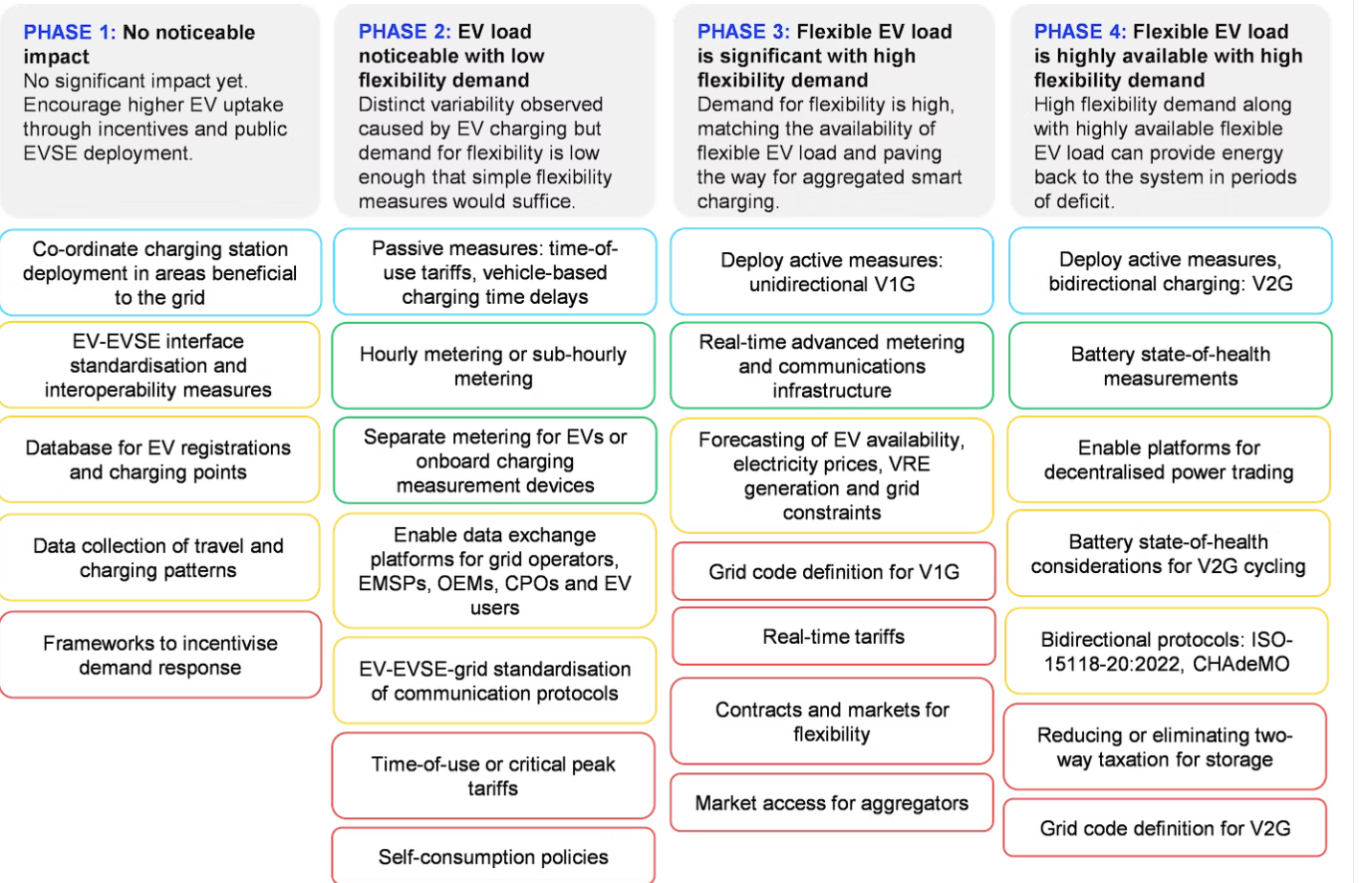 Deploying measures for the grid integration of EVs While electric mobility can have significant impacts on the grid, several measures exist to mitigate the impacts and turn them instead into opportunities for flexibility. This manual provides a simple framework for EV grid integration to help policy makers prioritise charging strategies according to the conditions of their EV uptake and power system needs. The framework is structured around four phases corresponding to increasing volumes of flexible EV load and increasing system demand for flexibility. The main strategy is to maximise the amount of managed charging, as opposed to unmanaged charging. Cost-effective charging solutions that help accelerate the shift to electric mobility should be accommodated by the grid, but opportunities to maximise the share of managed charging should be pursued when possible. Measures to mitigate unmanaged charging and encourage managed charging include providing locational signals, making connections non-firm at certain power levels or at certain times of the day, requiring storage or storage fees, and making the connection fee dependent on power demand or the controllability of the connected EV charger. In order to unlock the technology and business models necessary to provide flexibility through managed charging, the flexibility needs to be valued and remunerated. Policy makers can use tools such as tariff design, contracts and markets for flexibilities, and participation in wholesale markets to reward managed charging. Individual EVs may be too small to participate in most power markets, but this can be resolved through standardisation and interoperability measures, thereby aggregating sufficient numbers of vehicles. Electric mobility is also an unprecedented opportunity to grow the share of variable renewables in the power system. EV charging can be co-ordinated with variable renewable energy generation through incentives and measures to allow the contracting of renewables capacities. Finally, with all of the potential benefits of managed charging, policy makers should incentivise the smart-readiness of ecosystems through minimum communication and control requirements. Improving power system planning The rate of electrification of transport and other loads, and the potential cost savings they provide, calls for a fundamental improvement in planning practices to ensure the power system is ready to accommodate and take advantage of them as distributed energy resources. Co-ordinated and integrated planning practices are becoming essential. These ensure that power sector plans are well co-ordinated within the power sector and with other sectors. In particular, grid planning needs to be proactive and anticipate various needs for expansion rather than respond to new requests for connection. Mandated time windows of interconnection and the publication of hosting capacity maps can help streamline interconnection processes. Meanwhile, capacity building to develop modelling capabilities and regulatory incentives tied to supporting electric mobility can help grid operators proactively plan for EV charging demand. Finally, the scenarios and plans for the power sector need to properly reflect the full value of EV charging. Revisiting regulatory design to reduce bias on capacity expenditure helps grid operators put more focus on leveraging available flexibility and reducing costs for everyone. Likewise, revisiting criteria for grid expansion and system planning can help ensure that the cost savings from EV charging flexibility are recognised and accounted for when developing grids. |